
Succession Planning When the Obvious Successor Leaves Suddenly
Most succession planning rests on a quiet assumption. There is someone ready. The deputy who has been prepared for years, the obvious successor everyone expects to step up. Then that person resigns on a Tuesday morning, and the plan that looked so reassuring on paper turns out to guard against every departure except the one nobody prepared for.
A senior leader leaving without warning is not a rare event. It is one of the most common ways a succession plan is tested, and one of the ways it most often fails. This article looks at what succession planning is really for, why the obvious successor is so frequently the weak point, and how organisations build genuine continuity rather than a single name in a box.
What succession planning actually means
Succession planning is the process of identifying and preparing the people who will take over critical roles when current leaders move on. The definition matters, because the term is so often confused with simple replacement hiring. The meaning of a succession plan reaches well beyond naming a deputy. It covers the capabilities a role will need in future, the development required to build those capabilities, and the contingencies that hold an organisation steady when a transition arrives earlier than anyone hoped.
Done properly, a succession plan is not a document that sits in a drawer until the annual review. It is a living view of where leadership strength exists, where it is thin, and what the business would do tomorrow if a key figure walked out today.
Why the obvious successor is the weakest point in the plan
The heir apparent carries a hidden risk. Boards invest years of attention in one individual, and in doing so they quietly stop developing anyone else. The plan becomes a plan for a person rather than a plan for a role. When that person leaves, and capable people in demand do leave, the organisation discovers that its succession plan was a list of one.
There is a second problem. The obvious successor is rarely tested against the role the business will actually need. They are favoured because they are familiar, trusted and next in line, not because they are the strongest leader available. We have written elsewhere about how organisations tend to advance the most visible people rather than the most capable. Comfort is not the same as readiness, and a sudden exit exposes the difference at the worst possible moment.
The real cost of an unplanned leadership transition
When a senior leader departs suddenly, the cost is rarely confined to the empty seat. Decisions stall. Confidence wavers among customers, investors and the team left behind. In a listed business, an unmanaged chief executive transition can move the share price within days. CEO succession is the sharpest example, yet the same dynamic applies to any role where authority, relationships and knowledge are concentrated in one person.
The damage compounds with time. An appointment made in a hurry, under pressure, is far more likely to fail. The organisation can then find itself running the same expensive leadership transition twice inside two years, having lost momentum on both occasions.
What strong succession planning covers
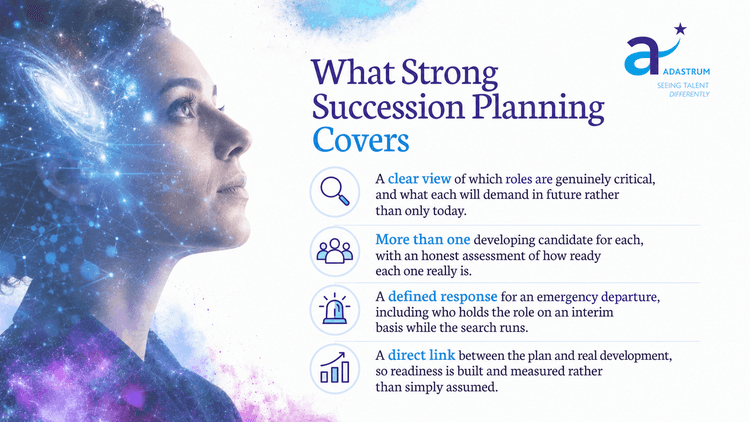
A succession plan that survives a sudden departure tends to share a few traits. It looks at roles rather than personalities. It keeps more than one credible candidate in view for every critical position. And it separates the immediate question, who keeps the organisation running next week, from the longer question, who should lead it for the next decade. In practice, a resilient plan covers:
- A clear view of which roles are genuinely critical, and what each will demand in future rather than only today.
- More than one developing candidate for each, with an honest assessment of how ready each one really is.
- A defined response for an emergency departure, including who holds the role on an interim basis while the search runs.
- A direct link between the plan and real development, so readiness is built and measured rather than simply assumed.
Building continuity, not just a name
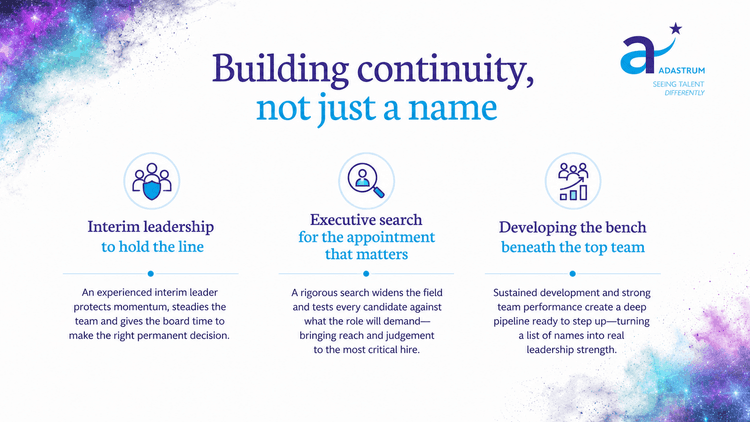
Continuity is rarely the product of a single document. It is the result of three capabilities working together: cover for the immediate gap, a rigorous search for the permanent appointment, and the steady development that keeps the bench deep enough to draw on.
Interim leadership to hold the line
When a departure cannot wait for a full search, an experienced interim manager keeps the organisation moving. A well chosen interim appointment protects momentum, steadies the team and gives the board the time to make the permanent decision properly rather than under duress. For many organisations, interim management is the single most effective answer to a sudden senior gap.
Executive search for the appointment that matters
The permanent successor deserves a considered process, not a quick internal nod. A rigorous executive search widens the field beyond the obvious internal candidate and tests every shortlisted leader against what the role will demand. For boards appointing at the most senior level in the capital, a specialist London executive search firm brings both the reach to find unconventional candidates and the judgement to assess them honestly.
Developing the bench beneath the top team
Resilience is built long before a resignation lands. Sustained leadership development deepens the pool of people genuinely ready to step up, while structured work on team performance ensures the layer beneath the executive can absorb change rather than fracture under it. A plan supported by real development is the difference between a list of names and a leadership pipeline.
Succession planning for business owners and founder led companies
For business owners the question is sharper still. In many founder led and family businesses, the leader is also the relationship holder, the final decision maker and, in effect, the brand. Business succession planning here is not only about who runs the company. It is about transferring trust, knowledge and authority in a way the business can actually survive. Company succession planning of this kind benefits from an outside perspective, drawing on the right sector expertise, because the hardest conversations are often the ones an owner cannot have alone.
Questions every board should be asking
- If our most likely successor resigned tomorrow, who would hold the role next week, and who would we appoint within six months?
- Are we developing more than one credible candidate for each critical role, or quietly relying on a single name?
- When did we last test our assumptions against what the role will demand in three years, rather than what it demands today?
- Does our plan clearly separate emergency cover from the permanent decision?
Continuity is a decision, not a document
Succession planning fails when it becomes an annual formality, a form completed and forgotten. It works when a board treats it as a continuing decision about the resilience of its leadership. The obvious successor may well turn out to be the right answer. The point is to have more than one answer ready, and a plan that holds when the unexpected arrives.
If you would like to pressure test your own succession planning, or you are facing a leadership gap that cannot wait, Adastrum's team works with boards and owners to protect leadership continuity through executive search, interim management and leadership development. Get in touch for a confidential conversation.
Frequently asked questions about succession planning
What is succession planning?
Succession planning is the process of identifying and preparing people to take over critical leadership roles when current post holders leave. A strong succession plan looks at the future demands of each role, develops more than one candidate, and sets out what the organisation will do if a leader departs without warning.
What happens if a company has no succession plan?
Without a plan, a sudden departure tends to trigger a rushed appointment, a loss of momentum and a dip in confidence among staff, customers and investors. The replacement made under pressure is more likely to fail, which often means repeating a costly leadership transition within a year or two.
How is CEO succession planning different?
CEO succession planning carries higher stakes because authority, strategy and external relationships are concentrated in one role. Boards are expected to maintain both an emergency plan, naming who would step in immediately, and a longer term plan that develops and assesses credible candidates over time.
Can interim management help during a sudden leadership departure?
Yes. An interim manager can hold a critical role within days, steadying the organisation and protecting momentum while the board runs a proper executive search for the permanent successor.
More on succession planning
Private Equity CEO Turnover: What the Deal Data Says About Timing and Returns
In three studies of large buyouts, about seven in ten companies changed their CEO under private equity ownership. We read the deal data and the surveys behind the widely quoted figures to see when the changes happen and how they relate to holding periods and returns.

Succession: Are You Developing the Right People, or the Loudest?
Succession planning too often rewards visibility over viability. The squeaky wheel gets noticed, but the quiet engine actually keeps the organisation moving. In many businesses, the squeaky wheel ends up on the succession plan simply because it is easier to see. That shortcut is getting riskier. With employers expecting nearly 40% of workers’ core skills to change by 2030, the signals we use to identify future leaders need to change as well.

In Three Years, I’m Going to Fire You
Imagine accepting a senior leadership role and, in the same conversation, being told the date you will be let go. Not as a threat. Not as a warning. As a feature of the offer. That is exactly how one HR director I worked with used to transformational senior hires. After walking the candidate through salary, package, incentives, all the usual bits, she would lean in and say something close to this: